Two quotes land in your inbox for the same bathroom. One says $22,000. The other says $29,500. Same room, same brief, same photos of the tiles you liked. So what gives?
Nine times out of ten, the gap has almost nothing to do with the builder’s margin. It comes down to the bathroom renovation inclusions: what each quote genuinely covers, and what it quietly leaves as a guess to be sorted out later. The cheaper quote often isn’t cheaper at all. It’s just less finished on paper.
Three phrases do most of the heavy lifting here, and they’re the ones homeowners tend to skim past. Allowances. Prime cost items. Provisional sums. Understand those three and you can compare any two bathroom quotes properly, spot which one is likely to creep, and walk into a contract knowing where your money can actually move.
Here’s what each one means in plain English, how they behave once the job starts, and what Queensland contract rules require your builder to put in writing.
What Bathroom Renovation Inclusions Actually Cover
An “inclusion” is anything the quoted price is genuinely committed to delivering. In a well-written bathroom quote, that splits into three buckets, and knowing which bucket each line sits in tells you almost everything.
- Fixed inclusions: a specific item or task, at a specific price, already locked in. A named toilet suite. Waterproofing to Australian Standards. Tiling to 2100mm in the shower recess.
- Allowances: a budget figure held in the price for something not yet chosen or not yet fully known. This is where prime costs and provisional sums live.
- Exclusions: anything the price does not cover. Waste removal, asbestos testing, strata approvals and electrical upgrades are the usual suspects.
The trap isn’t allowances themselves. Allowances are a legitimate and often unavoidable part of renovating, because nobody can price a tile you haven’t picked or a subfloor nobody has seen. The trap is a quote stuffed with allowances that reads like a fixed price.
Prime Cost Items: The Allowance for Things You Haven’t Chosen Yet
A prime cost item, usually shortened to “PC”, is a dollar allowance for a fixture or fitting you’ll select after signing. Think tiles, tapware, the vanity, the shower screen, the mirror.
Under Queensland law a prime cost item is defined as something that hasn’t been selected, or whose price isn’t known, at the time the contract is signed, and for which the builder makes a reasonable allowance for supply and delivery.
Say your quote carries a tile allowance of $38 per square metre. You then fall in love with a large-format porcelain at $72 per square metre. That difference is yours to pay. Go the other way and pick something at $30, and you should receive a credit for the unused portion.
One detail worth pinning down: a prime cost allowance generally covers the supply of the item, not the labour to install it. Installation usually sits in the main contract price. But if you choose a fussier product, the labour to fit it can change too, and that will come at you as a separate variation. Mosaic tiles are the classic example. Small format, more cuts, more setting out, more hours.
Provisional Sums: The Allowance for Work Nobody Can Price Yet
A provisional sum, or “PS”, is different. It’s an estimate for a piece of work, including any materials that work needs, where the builder genuinely cannot give a firm number when the contract is signed.
Bathrooms produce these constantly, because so much of the story is hidden behind tiles. Common provisional sums include:
- Repairing a rotted or water-damaged subfloor once the old floor comes up
- Rectifying failed waterproofing found during demolition
- Upgrading old plumbing that no longer meets current standards
- Asbestos removal in homes built before the 1990s
- Making good uneven or out-of-square walls before tiling
Provisional sums behave the same way financially. Come in over the estimate and you pay the difference. Come in under and you should get a credit variation for the balance.
Prime Costs vs Provisional Sums at a Glance
| Prime Cost Item (PC) | Provisional Sum (PS) | |
|---|---|---|
| What it covers | A product: fixture or fitting | Work: labour plus any materials |
| Why it’s an allowance | You haven’t selected it yet | The scope can’t be known yet |
| Bathroom examples | Tiles, tapware, vanity, toilet, screen | Subfloor repair, asbestos removal, plumbing upgrades |
| Who controls the outcome | You, through your selections | The condition of the building |
| If it costs more | You pay the difference | You pay the difference |
| If it costs less | You should receive a credit | You should receive a credit |
What Queensland Contract Rules Require
This is where Queensland homeowners have more protection than most people realise, and it’s worth knowing before you sign anything.
Domestic building work in Queensland has to be under a written, dated and signed contract once the value passes $3,300. Between $3,301 and $19,999 that’s a Level 1 contract. At $20,000 and above it becomes a Level 2 contract, which most full bathroom renovations will be.
Level 2 contracts carry extra obligations that matter directly to this topic. If the price is a fixed amount with no allowances, that price and a price change warning have to appear on the first page of the contract schedule. If the price isn’t fixed, the method for calculating it, including any allowances for prime cost items or provisional sums, must be set out in the contract schedule. Your builder also warrants that those allowances have been calculated with reasonable care and skill. The QBCC’s guidance on contracts and agreement types sets all of this out for homeowners.
In practice that means a builder can’t lowball an allowance to win the job and then treat the blowout as your problem. An allowance pitched unrealistically low isn’t clever pricing, it’s a breach of that warranty.
Worth knowing too: any change to the agreed scope should be documented as a written contract variation before the work happens, not discovered on the final invoice. And be genuinely cautious about cost plus contracts, where no fixed price exists at all. The QBCC has reported that homeowners on these arrangements frequently end up paying 50% to 100% more than they expected.
Red Flags in a Bathroom Renovation Quote
Once you know what to look for, a thin quote gives itself away fast. Run yours past this list.
- Waterproofing described only as “to code”. It should name the standard. Wet area waterproofing in Australian homes is governed by the National Construction Code and AS 3740, and you should be handed a certificate at completion.
- No tiling heights specified. “Tiling included” could mean a 300mm skirt or full-height walls. The difference is thousands.
- A long list of PC items with vague figures. Five or six allowances on a bathroom is normal. Fifteen means you’re being quoted a range dressed up as a price.
- Waste removal and skip hire missing. A bathroom strip-out generates a serious amount of rubble.
- No named products anywhere. If nothing is specified, nothing is promised.
- A verbal or emailed number with no site visit. Nobody can price a bathroom they haven’t stood in.
How Package Pricing Removes Most of the Guesswork
The reason we built our all-inclusive bathroom packages the way we did is that most allowance-related pain comes from one thing: decisions left open too long.
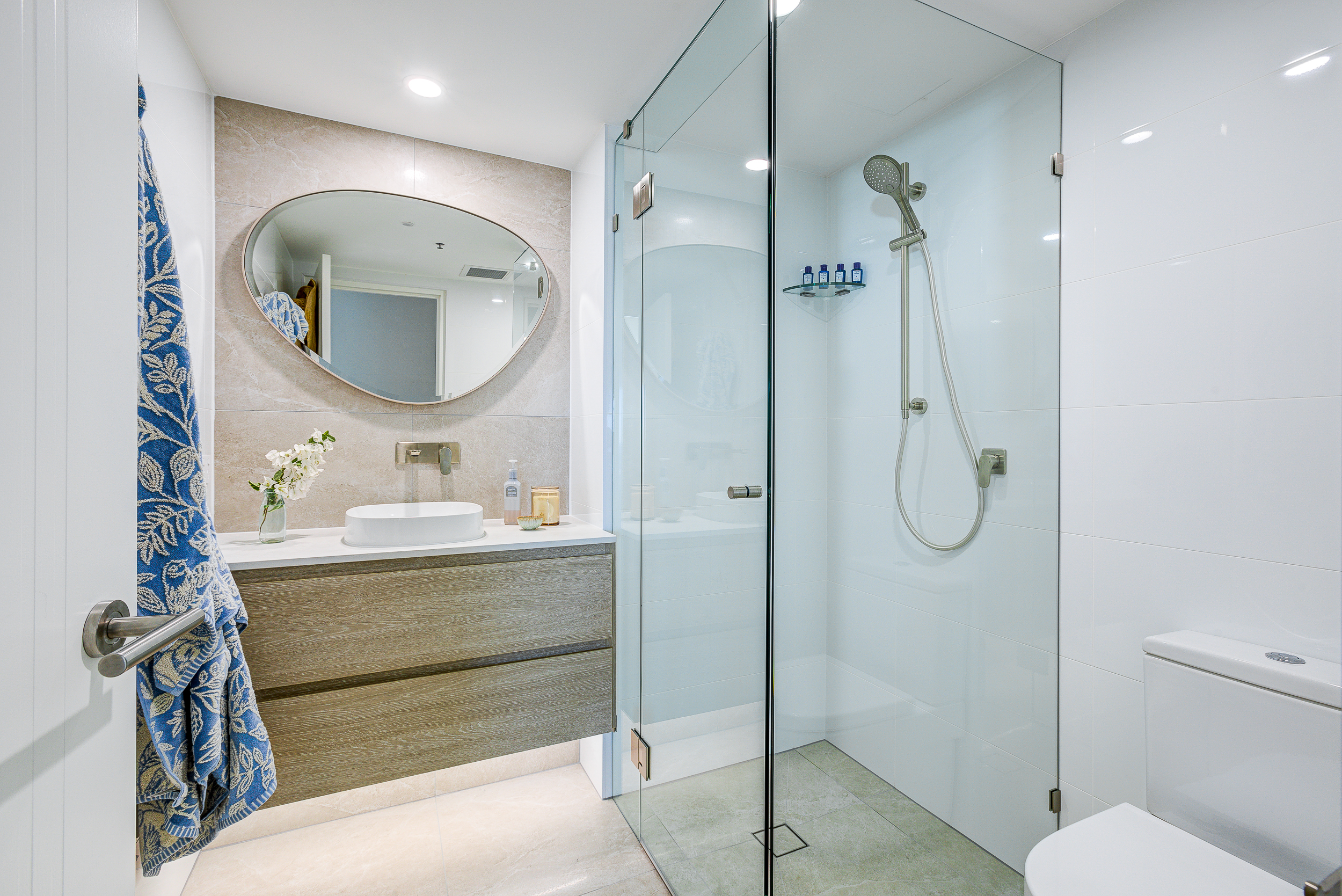
When the fixtures are pre-selected, the tile layout is drawn, and the tiling heights are documented up front, there’s very little left to hold an allowance against. Our Essentials collection names the vanity, the tapware, the toilet suite, the screen and the mirror, and specifies the tile plan down to a 300mm skirt to the perimeter, half wall tiles behind the bath to 1200mm and shower walls to 2100mm. Plus and Premier step the finishes up while keeping the same clarity.
Because we manage design, demolition, waterproofing, tiling, plumbing and electrical in-house across the Gold Coast, Logan and Brisbane’s southside, there’s also no gap between trades where a surprise cost can hide. Where a genuine unknown exists, and in a 1980s Southport unit it sometimes will, we tell you about it before you sign rather than after the tiles come off. Our FAQs cover how tiling and product selections are handled, and every job is backed by a 6 year workmanship warranty.
Frequently Asked Questions
What is the difference between a prime cost item and a provisional sum?
A prime cost item is an allowance for a product you haven’t selected yet, such as tiles or tapware. A provisional sum is an estimate for work that can’t be accurately priced when the contract is signed, such as repairing a subfloor nobody has seen. One is about what you choose, the other is about what’s found.
Do I have to pay if I go over a prime cost allowance?
Yes. If you select something dearer than the allowance held in the contract, the extra cost is yours. This should be documented as a written variation before the item is ordered so there are no surprises at the final invoice.
What happens if the actual cost comes in under the allowance?
You should receive a credit for the unused amount, which reduces what you owe. This works both ways, and it’s a fair question to ask a builder directly before signing.
Does a prime cost allowance include installation?
Usually not. A prime cost allowance typically covers supply and delivery of the product, with installation labour sitting in the main contract price. Selecting a more complex product can still change the labour, so ask how that’s treated.
Should a bathroom renovation quote have any allowances at all?
A small number is perfectly normal and often unavoidable. What you want is transparency: each allowance clearly labelled, realistically costed, and explained. A quote with no allowances and no specified products is usually less honest than one with a handful of clearly stated ones.
Final Thoughts
Comparing bathroom quotes on the headline figure alone is like comparing two flights on price without checking whether either includes luggage. The number tells you very little on its own.
Ask for the inclusions list. Ask which lines are allowances and why. Ask what happens if an allowance is exceeded, and what happens if it isn’t. A builder who answers those three questions comfortably is a builder who has actually priced your bathroom rather than estimated it.
If you’d rather skip the guesswork entirely, request a quote and we’ll measure up your space, walk you through exactly what’s included at each package level, and put it all in writing before you commit to anything.