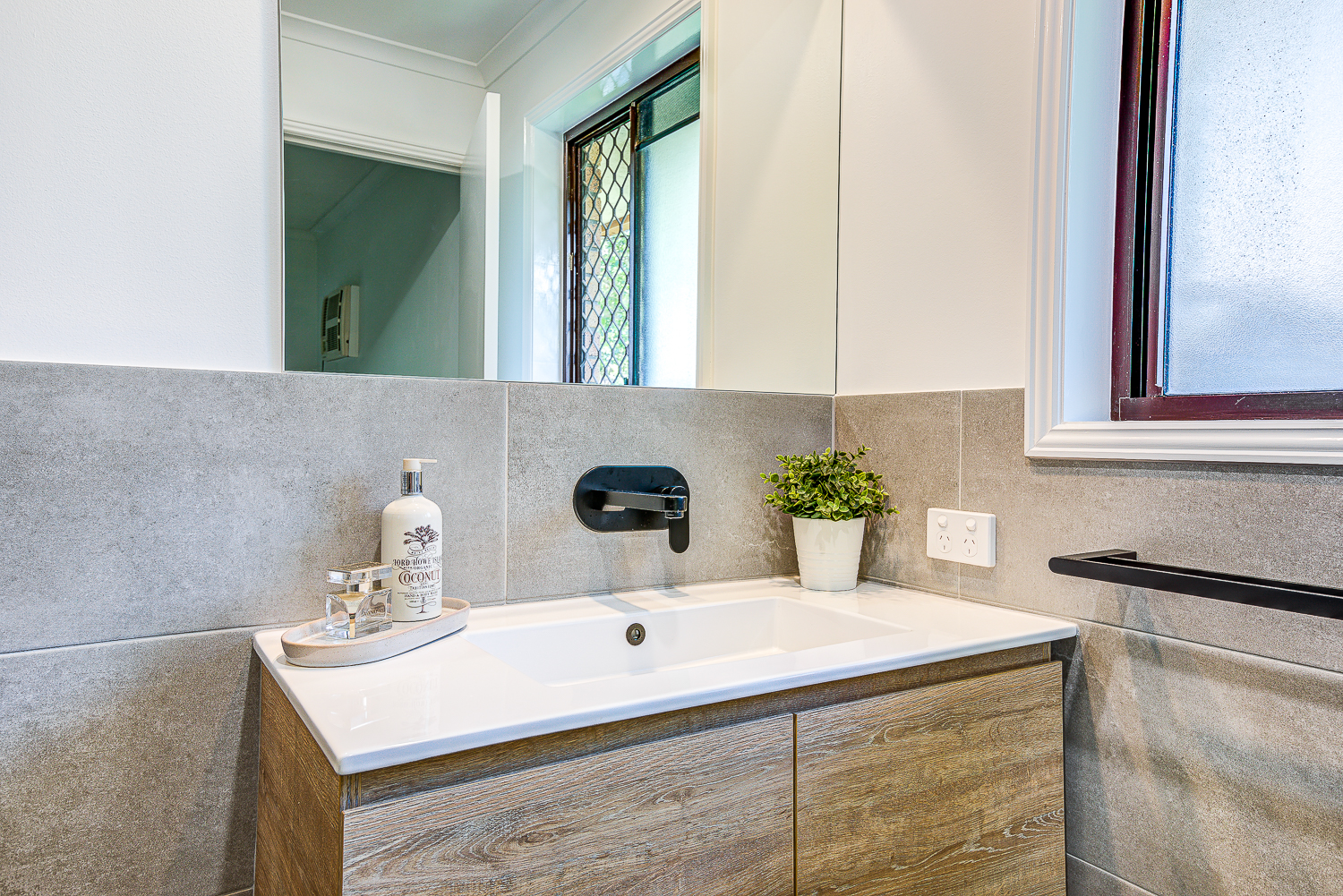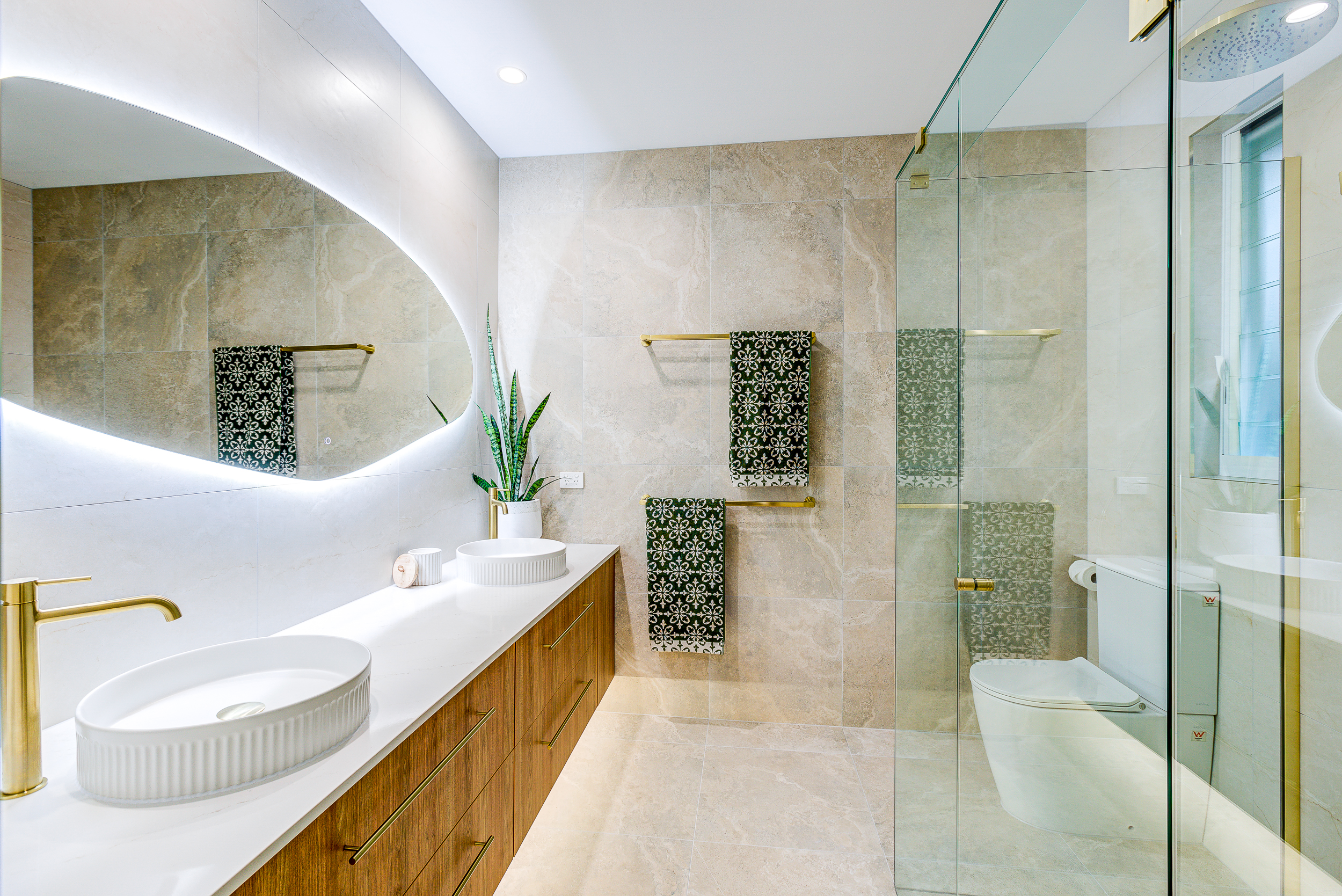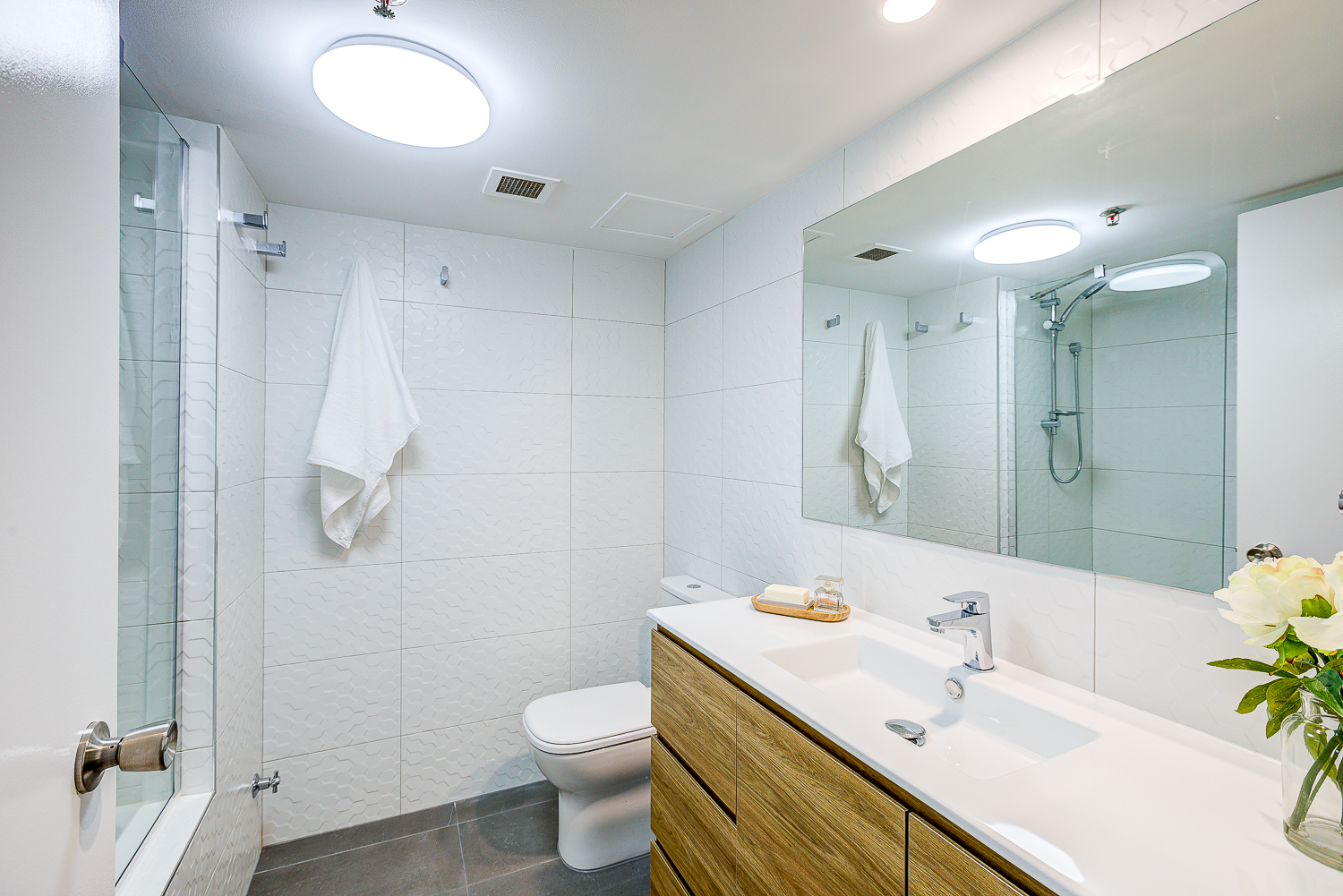
The cold, clinical, all-white bathroom is officially over. The bathroom trends 2026 we’re seeing roll out across Gold Coast, Logan and South Brisbane renovations are warmer, more tactile and a lot more personal. Homeowners are done with spaces that look like hotel lobbies and are instead asking for bathrooms that feel like a continuation of the rest of the home: considered, calm, and built to last well beyond a single design cycle.
So what’s actually changing? Curves are replacing hard corners. Warm neutrals are replacing stark white. Natural stone and earthy tiles are taking over from glossy subway tiles. And smart storage is finally getting the attention it deserves. Below we’ve broken down the eleven biggest bathroom trends 2026 Australian homeowners are choosing right now: what they look like, why they work, and how to bring them into your own renovation without the space feeling dated in five years.
1. Warm Neutrals Replacing Crisp White
The biggest shift in 2026 is a full move away from bright, cool whites toward softer, warmer neutrals. Think putty, mushroom, warm taupe, bone, greige and sandy off-whites, all tones that feel lived-in rather than sterile. These colours photograph beautifully, they age well, and they pair naturally with timber, brass and stone.
Warm neutrals also solve a very practical problem: they hide water spots, limescale and daily wear far better than pure white, which means your bathroom still looks new six months after handover. For South East Queensland homes bathed in strong natural light, warm neutrals also stop the space from feeling glaring on a sunny afternoon.
2. Curves, Arches and Softer Silhouettes
Hard, boxy corners are being softened everywhere in 2026. Arched mirrors, curved vanities, rounded bath edges and arched shower niches are showing up in almost every new bathroom design we see. Even tapware is going softer, with gently curved spouts replacing the sharp right-angled shapes that dominated the last decade.
The appeal is partly visual. Curves create a calmer, more spa-like feel, but they’re also practical. A curved vanity with no sharp corners is safer in a tight family bathroom, and arched niches are easier to live with than hard-edged rectangles that catch soap and grime.
3. Natural Stone and Stone-Look Tiles
Travertine, limestone, marble and organic stone-look porcelain are the tile story of 2026. Homeowners want texture and movement underfoot, not the flat, uniform ceramics that defined previous years. Large-format stone-look tiles (600x600mm and up) are particularly popular for shower floors and feature walls, because they reduce grout lines and make small bathrooms feel larger.
If you love the look but not the sealing and maintenance of real stone, porcelain stone-look tiles have caught up remarkably in the last two years. The printing, texturing and edge finishing are now close to indistinguishable from the real thing, and they’re far more forgiving in a high-use family bathroom. For more on how tile layout affects the final look, see our guide to tile laying patterns that work in Australian bathrooms.
4. Brushed Brass and Warm Metals
Chrome is quietly retiring. Brushed brass, aged brass, warm gold and champagne finishes are the dominant tapware and hardware choice for 2026, followed by matte black (still strong) and brushed nickel (making a steady comeback for buyers who want warmth without the yellow undertone).
One tip worth taking seriously: stick to one metal finish through the whole room, or at most two that share the same tonal family. Mixing brushed brass, chrome and matte black in the same bathroom is one of the fastest ways to make a brand-new renovation feel chaotic. If you’re worried about committing, Beaumont Tiles’ guide to modern bathroom design has good visual examples of how to mix metals without it getting messy.
5. Freestanding Baths in the Main Bathroom
Freestanding baths are no longer reserved for luxury en-suites. In 2026, they’ve become the centrepiece of the main family bathroom, often positioned under a window or against a feature-tiled wall. The silhouettes are softer too: gently oval, shallower-ended and smaller in overall footprint, which matters for the compact bathrooms common in Gold Coast apartments and townhouses.
For families, the trend is also practical. A smaller freestanding bath takes up similar space to a built-in tub but dramatically changes how the room reads, adds resale appeal, and makes the bathroom feel more like a retreat than a utility room.
6. Fluted, Ribbed and Textured Surfaces
Flat is out. Vertical fluting on vanity doors, ribbed glass on shower screens, reeded feature walls and tactile 3D tiles are all showing up strongly in 2026 renovations. Texture adds depth and interest without needing bold colour, which is why it’s working so well alongside the softer, more neutral palettes.
Used sparingly, texture transforms a bathroom. Used everywhere, it looks busy and dates quickly. A safe approach is to pick one textured element, usually the vanity or a single feature wall, and keep the rest of the room clean and calm.
7. Smart, Hidden Storage
One of the most useful bathroom trends 2026 is less visible but changes daily life the most: integrated storage. Wall-hung vanities with deep drawers, recessed shower niches, mirror cabinets with internal power points (for electric toothbrushes and shavers), and full-height custom storage towers are replacing the old “pedestal basin and hope for the best” approach.
The benefit is obvious: a bathroom that stays tidy because everything has a home. Wall-hung vanities in particular make small bathrooms feel larger because you can see the floor running underneath them, which is a genuinely good trick in tight apartment layouts.
8. Large-Format Tiles and Fewer Grout Lines
Grout-heavy designs are being replaced by larger tiles that reduce visible grout lines and make cleaning easier. Popular formats in 2026 include 600x1200mm, 600x600mm and oversized 1200x2400mm slab-style porcelain for shower walls. The result is a cleaner, more seamless finish that photographs beautifully and ages well.
There’s also a quiet waterproofing benefit: fewer grout lines mean fewer potential failure points over the long term. That said, tile size is only half the story. What keeps water out is the waterproofing membrane underneath, which needs to meet Australian Standard AS 3740 on every bathroom renovation. The Australian Building Codes Board sets the compliance framework that licensed bathroom renovators follow, and cutting corners on waterproofing is the single biggest cause of bathroom renovation failures.
9. Earthy, Moody Feature Walls
Homeowners are getting braver with feature walls in 2026. Terracotta, deep olive, burgundy, forest green and mushroom are all being used to add personality to an otherwise calm palette. Usually, this shows up as a single tiled feature wall (often behind the vanity or inside the shower), while the rest of the room stays neutral.
This is the 2026 answer to people who want personality without committing to bold colour everywhere. If you paint yourself into a corner with a whole-room colour choice, you’ll regret it. One considered feature wall gives you the drama without the long-term risk. If you’re not sure which style suits your home, our bathroom style quiz is a quick way to narrow it down.
10. Timber and Timber-Look Accents
Warm timber vanities, timber-look tiles on floors, and timber-framed mirrors are everywhere in 2026 renovations. The warmth of timber is the perfect counterpoint to stone and neutrals, and it’s the fastest way to make a bathroom feel less “bathroom-y” and more like part of the home.
For Queensland’s humid climate, timber-look porcelain tiles and properly sealed engineered timber vanities are the smart choice over solid timber, which can warp, swell and stain over time. You get the warmth and the character without the ongoing maintenance headaches.
11. Wellness Features: Rainfall Showers, Double Vanities and Heated Towel Rails
The final trend is less about style and more about how the bathroom makes you feel. Rainfall shower heads with a handheld attachment, double vanities in the main bathroom (not just the ensuite), heated towel rails, in-floor heating and even steam showers are showing up in mid-tier renovations that would have been strictly luxury-only five years ago.
This shift reflects a bigger change in how Australians think about bathrooms. Home Beautiful’s renovation guide describes the modern bathroom as “a private retreat” rather than a utility space, and that mindset shows up in the spec list: fewer fittings, but each one chosen carefully for the experience it delivers every morning.
How to Apply Bathroom Trends 2026 Without Dating Your Space
A quick reality check before you start picking finishes. Trends are a great starting point, but a terrible design brief on their own. The bathrooms that still look good in ten years tend to follow three rules:
- Keep the big, expensive items timeless. Bath, basin, toilet, vanity carcass, floor tile. These are the things that cost the most to change later, so pick shapes and colours that won’t embarrass you in five years.
- Let the trends live in the easy-to-swap items. Tapware, accessories, paint, mirrors, and towel rails. These can be updated affordably when the look starts to feel tired.
- Pick a palette and stick to it. Two to three hero materials, one metal finish, one feature element. Anything more and the space starts to feel overdesigned.
If you’re planning a renovation and want to see how the 2026 trends translate into real, completed projects, our before-and-after gallery shows what these finishes look like in Gold Coast homes, and our bathroom renovation packages are built around the same timeless-base-plus-on-trend-finishes approach.
Frequently Asked Questions
What is the biggest bathroom trend in 2026?
Warm neutrals replacing crisp white is the single biggest bathroom trend in 2026. Homeowners are choosing tones like putty, mushroom, greige and warm taupe over the stark whites that dominated the last decade. The shift is partly aesthetic and partly practical: warm neutrals hide water spots and wear better, and they pair naturally with the natural stone, timber and brass finishes that are also on trend.
Are freestanding baths still in style in 2026?
Yes, freestanding baths are still a core feature of 2026 bathroom design, but the silhouettes have evolved. Expect softer oval shapes, shallower ends and smaller overall footprints compared to the oversized freestanding tubs of 2020–2022. This makes them more practical for compact Australian bathrooms and apartment renovations without losing the statement look.
What colours are trending in bathrooms in 2026?
Warm neutrals dominate: putty, mushroom, bone, greige, sandy off-whites and warm taupe. For feature moments, earthy tones like terracotta, olive, burgundy and forest green are being used on single feature walls. Cool greys and stark whites are the main colours being phased out.
Is Chrome tapware out in 2026?
Chrome isn’t completely dead, but it’s no longer the default choice. Brushed brass, aged brass and warm gold finishes are leading the market in 2026, with matte black still strong and brushed nickel making a return for homeowners who want warmth without gold undertones. The key rule is to stick to one metal finish throughout the bathroom for a cohesive result.
How long do bathroom trends typically last?
Most bathroom trend cycles run five to seven years before they start to feel dated, which is why the smart approach is to keep the expensive, permanent items (bath, toilet, vanity, floor tiles) timeless and let the trends live in easier-to-swap elements like tapware, accessories and paint. If you want more on planning a renovation properly, CHOICE’s guide to bathroom renovation traps is worth reading before you commit.
How much do these 2026 bathroom trends add to a renovation cost?
Most of the 2026 trends are about finish selection rather than structural upgrades, which means they don’t add as much to the cost as homeowners often assume. A stone-look porcelain tile costs similarly to a standard ceramic tile. A fluted vanity door costs a modest premium over a flat one. The big cost drivers in any renovation remain the same: size of the space, scope of structural changes, tile selection and tapware spec. A packaged renovation approach lets you lock in the 2026 look with predictable pricing upfront.
Final Thoughts
The bathroom trends 2026 that will actually stand the test of time share one thing in common: they’re warmer, softer and more tactile than what came before, and they’re designed to feel like part of the home rather than a separate utility space. Warm neutrals, natural stone, brushed brass, curves, and smart storage are the five ideas worth building a renovation around. Everything else is seasoning.
If you’re ready to renovate and want to see how these trends look when they’re pulled together properly by a licensed local team, get in touch with Capital Bathrooms for a no-obligation consultation. We’ll walk you through your options, your budget and the finishes that will still look good long after the 2026 trend cycle has moved on.